
Functional, the non-stick pan is invaluable in the kitchen. And rightly so, since, as you’ve probably guessed, it has this remarkable ability to prevent food from sticking to its surface. But beware, it’s not as versatile as you think. Many people don’t know about it, but it doesn’t systematically adapt to all foods. It only takes a few recurring mistakes for it to end up spoiling prematurely. Here are some rules to follow to make your non-stick pans last.
What foods should not be cooked in a non-stick pan?
First rule of thumb: non-stick pans should never be used at high temperatures. They should also never be left empty to preheat.
Below we list the foods that you should avoid cooking in this type of cookware. Otherwise, it is the best way to spoil them faster.
Avoid cooking acidic ingredients in your non-stick pan
By this we mean all acidic and spicy foods, such as citrus fruits or tomatoes. If you are used to using your non-stick pan to cook these foods, over time it will suffer and become less functional. It is better to stop the damage today.
Avoid cooking meat in your non-stick pan.
It is tempting to use this type of pan to cook slices of steak, but since meat requires high temperatures for optimal cooking, this utensil is not suitable. Your pan should not be used on high heat.
Avoid preparing sauces in your non-stick pan
Just like meat, nonstick cookware is not suitable for preparing sauces that can caramelize and stick to the heat.
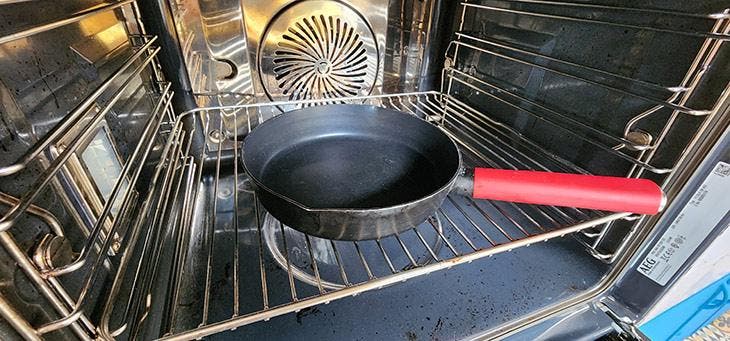
For your information
Some non-stick pans can be put in the oven. In fact, you can easily find them on the market. This is usually specified on the back of the pan. So be careful and always consult the manufacturer’s instructions.
Frequently Asked Questions
How to prevent your non-stick pan from sticking?
As we mentioned earlier, non-stick pots and pans are not designed for high temperatures. And, of course, you can notice that they start to smoke when the heat is hot.
They should really only be used for cooking easy-to-prepare dishes, such as pancakes or an omelette. Another mistake to avoid: using fat. Of course, it’s not a big deal, but in the long run, as the food slides more easily in the pan, it may partially stick and the burnt residue will be harder to remove. That’s why it would be better to use just a drop of oil or a little butter.
Also be sure to avoid using metal utensils when handling non-stick pans. They are likely to scratch them and encourage food to stick. Instead, opt for wooden, plastic (special for cooking) or silicone spatulas. Finally, it is not recommended to clean your non-stick pan in the dishwasher: hot water and harsh detergents can damage it over time. The best option is to use a soft sponge moistened with a mixture of warm water and dish soap.
When to throw away a non-stick pan?
We tend to keep our cookware for many years. However, over time it wears out and becomes less efficient. To know if you need to replace your nonstick pots and pans, here are some factors to consider.
- Bought before 2015?: Generally, it’s recommended that non-stick pans be replaced after five years. But caution is advised, especially with non-stick cookware made before 2015, as it may contain “PFOA” (an industrial glue that holds Teflon together). So if your cookware is from 2015 or even earlier, it’s time to replace it. And that’s even if it doesn’t contain PFOA.
- Scratched or chipped coating : There was a time when, with older non-stick pans (containing PFOA), the appearance of scratches or cracks was a clear sign that the pan needed to be replaced, as the coating could flake off and penetrate into food. However, today, with the latest models, there is no need to worry about these scratches anymore, as today’s Teflon coating no longer contains PFOA and therefore no longer poses the same health risks. However, any damage to the surface of your pans reveals that its non-stick capabilities are no longer as effective. It is best to consider a replacement in the short term.
- Rust : When a non-stick pan loses its coating, the metal underneath is exposed to oxidation and can easily rust. While consuming small amounts of rust is not dangerous to your health, it can affect the taste of your food. Unless you find radical methods to remove this rust, you should probably replace your cookware.
- Dark discoloration : As you may have noticed, nonstick pans develop light or dark spots as food accumulates. In itself, the potential discoloration is not dangerous. But regardless, a darker color indicates that the coating is gradually peeling off. Again, it’s best to throw the pan or saucepan away.
- Food sticks : You’ll finally know it’s time to replace your non-stick pan when it no longer serves its primary purpose. If food sticks regularly, this is a clear indication that the coating has lost its non-stick ability.


