
Cucumbers are perhaps one of the easiest garden crops to grow. But this is in my opinion. For some reason, many people fail to do this: there are few ovaries, the fruits become pear-like or roll into a ball. And how is it that the plots are close, the weather conditions and the soil are the same, but the results are so different?
Variety selection
A mistake can be made even at the seed buying stage. Here’s the kicker. There are parthenocarpics: cucumbers that do not need pollination by bees and varietal (pollinated) varieties.

The former are often planted in a greenhouse, the latter – in the open field. Insect-pollinated cucumbers are definitely tastier and more aromatic. But why is it clear? This is just my opinion.
And so if you plant a pollinated variety in a greenhouse, it shouldn’t surprise you that there are ovaries, but they don’t grow, dry out, and fall off. This leads to another error (read below).
Drizzle with sugar syrup
You may come across the following recommendation: “To attract bees and bumblebees for pollination, sprinkle sugar syrup on the flowers and leaves.” This recommendation does not provide any benefit, but the harm can be significant.
A low-concentration “syrup” will attract ants, flies, and wasps may come. But bumblebees and bees definitely won’t come. And a strong concentration solution, first of all, if it gets into the flower, it will damage the pistil and you don’t need to wait for the ovaries to arrive.
Second, it will also lead to leaf damage after the sweet liquid begins to dry.
Irrigation
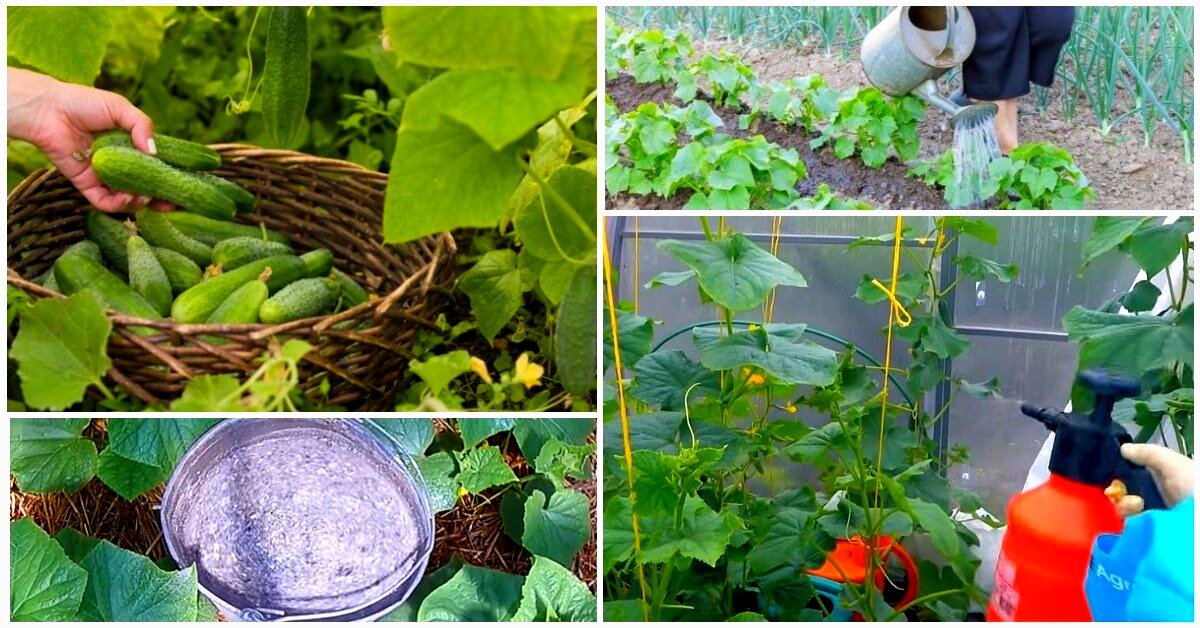
Cucumbers love it, but it is advisable to water them with warm water. Pour into barrels, let the water heat during the day, and water at night. Cold water can cause cucumbers to develop a “waistline” – they will taper in the middle. Another similar event can occur due to temperature changes between day and night. It’s harder to deal with in the open field than in a greenhouse.
Again, uneven watering and frequent drying of the soil also lead to fruit deformation. And it is not the dry soil itself that is to blame, but the fact that in such conditions insects can cross-pollinate hybrids and as a result there will be plenty of hooks, not cucumbers.
It turns out that improper watering is almost the main mistake. Cucumbers have roots near the surface of the soil. And because of infrequent watering, they dry out quickly. Therefore, the “oscillation” of irrigation, when “it is empty, then it is thick”, is the cause not only of diseases, but also of a sharp decrease in yield.
If regular watering is not possible, there is only one way out: apply mulch.
No supplemental feeding
Cucumbers don’t feed like tomatoes. There is a special focus for them. They love organic matter because it contains a lot of potassium, calcium, and nitrogen. And despite the lush foliage, cucumbers need little nitrogen; they need more potassium;
If potassium is lacking, fruits whose tips look more like a beak can be obtained again. In addition, a lack of potassium is a major cause of ovarian death and marginal yellowing of leaves.
Therefore, for a good harvest, it is not necessary to be lazy, but to add humus and compost to the beds. And add dolomite flour, because it contains calcium and magnesium. But putting different herbs in the holes and furrows is completely useless.
Too much fertilizer
And also about food. Again, you can find information about fertilizing with ammonium nitrate and ammonia.
They work with some vegetables. But not with cucumbers! Well, cucumbers don’t like acidic soil, but those fertilizers make it very acidic. Without growth, in the end there will be no harvest.


